- Pectin is a soluble prebiotic fiber found naturally in fruits, vegetables, legumes, and nuts that directly feeds beneficial gut bacteria to improve your microbiome health.
- When pectin ferments in your lower intestine, it produces short-chain fatty acids (SCFAs) like butyrate, propionate, and acetate — compounds linked to reduced gut inflammation and a stronger gut lining.
- Apples, citrus peels, berries, and carrots are among the richest food sources of pectin, and you only need 3 to 5 grams of prebiotic fiber daily to start seeing digestive benefits.
- Pectin behaves differently from other prebiotic fibers like inulin, beta-glucan, and resistant starch — understanding these differences can help you build a more complete gut health strategy.
- Food is still the most effective delivery method for pectin, but knowing when a supplement might be appropriate is something worth understanding before you make changes to your diet.
Most people have never thought about pectin as a gut health tool — and that is exactly why so many people are missing one of the most effective prebiotic fibers available through everyday food.
Pectin shows up in countless discussions about jam-making and food thickening, but its role as a prebiotic that actively nourishes your gut microbiome is far more significant. Microba, a leader in gut microbiome science, highlights pectin as one of several key soluble fibers — alongside inulin, beta-glucans, arabinoxylan, and resistant starch — that support a thriving gut ecosystem. Getting more of it into your daily diet is simpler than you might think.
Pectin Is One of the Most Powerful Prebiotics You Are Probably Not Thinking About
While most gut health information revolves around probiotic yogurts or kombucha, the real foundation of a healthy microbiome is what you feed the bacteria already living in your gut. Pectin does exactly that. It travels through your digestive system largely intact until it reaches your lower intestine, where your gut bacteria ferment it and use it as fuel. That fermentation process is where the magic happens.
What Pectin Actually Is
Pectin is a naturally occurring structural polysaccharide — essentially a complex carbohydrate — found in the cell walls of plants. It is what gives fruits their firmness and structure. When you eat an apple or bite into a carrot, you are consuming pectin without even realizing it. In food manufacturing, concentrated pectin is extracted and added as a thickening or gelling agent, but the pectin in whole foods works differently and more beneficially inside your body.
Pectin as a Soluble Dietary Fiber
Pectin belongs to the soluble fiber family, meaning it dissolves in water rather than passing through your gut as roughage. Once dissolved, it forms a thick, gel-like substance in your intestines. This gel slows digestion, helps regulate bowel movements, and creates the ideal environment for beneficial gut bacteria to ferment and thrive.
How Pectin Differs From Other Prebiotics Like Inulin and Beta-Glucan
Not all prebiotic fibers work the same way, and pectin has a distinct profile compared to other well-known options. Inulin, found in chicory root and garlic, feeds a slightly different set of gut bacteria and is known for being more rapidly fermented — which can cause bloating in sensitive individuals. Beta-glucans, concentrated in oats and barley, are particularly noted for their cholesterol-lowering effects alongside gut benefits.
Pectin ferments more slowly and gently in the gut, which tends to produce a more gradual, sustained release of short-chain fatty acids. This makes it particularly well-tolerated compared to some of the more aggressive prebiotic fibers. It also targets specific bacterial strains that other fibers may not reach as effectively.
Here is a quick comparison of where each prebiotic fiber comes from and what sets them apart:
- Pectin — Found in apples, citrus, berries, carrots; forms a gel, slow fermentation, gentle on digestion
- Inulin — Found in chicory root, garlic, onions; rapidly fermented, may cause gas in sensitive individuals
- Beta-Glucan — Found in oats, barley; supports cholesterol management alongside gut health
- Arabinoxylan — Found in wheat bran and whole grains; feeds a broad range of beneficial bacteria
- Resistant Starch — Found in cooked and cooled potatoes, green bananas; strong butyrate producer
Why Pectin Forms a Gel in Your Gut
When pectin contacts water in your digestive tract, its long polysaccharide chains cross-link and create a viscous gel matrix. This is the same property that makes pectin useful in jam-making, but inside your intestines, that gel slows the movement of food, buffers stomach acid, and physically creates a hospitable environment for beneficial microbes to colonize and feed.
How Pectin Feeds Your Gut Microbiome
Your gut microbiome is made up of trillions of bacteria, and the ones that have the most positive impact on your health depend almost entirely on what you eat to sustain them. Pectin is a preferred fuel source for several strains of beneficial bacteria, particularly those living in the lower digestive tract where fermentation is most active.
- Pectin reaches the colon largely undigested, intact enough for bacteria to use
- Beneficial bacteria break it down through anaerobic fermentation
- This process produces short-chain fatty acids as metabolic byproducts
- Those SCFAs then go on to support gut lining integrity, reduce inflammation, and regulate immune responses
Related reading: Healthy Gut Bacteria: How to Restore them and Detoxify
The Fermentation Process in Your Lower Digestive Tract
Fermentation in your gut is not a random process. Specific bacteria have evolved to produce the enzymes needed to break down complex polysaccharides like pectin. As they ferment pectin in your colon, they multiply, outcompete less beneficial bacteria for space and resources, and produce compounds that directly benefit your intestinal environment. This is why consistently eating pectin-rich foods has a cumulative, compounding effect on gut health over time.
Think of your colon as a garden. Pectin is the fertilizer that feeds the plants you actually want growing there. Without it, the less beneficial strains — the weeds — have an easier time taking over.
Short-Chain Fatty Acids: What They Are and Why They Matter
Short-chain fatty acids (SCFAs) are the primary output of pectin fermentation, and they are arguably the most important metabolites your gut bacteria produce. The three main SCFAs are butyrate, propionate, and acetate, each with distinct functions in your body.
Short-Chain Fatty Acid Primary Function Where It Acts Butyrate Fuels colonocytes (colon cells), reduces inflammation Colon lining Propionate Supports liver metabolism, regulates appetite hormones Liver and gut Acetate Feeds other gut bacteria, supports immune function Peripheral tissues
Butyrate in particular is considered the most critical for gut integrity. It is the preferred energy source for the cells lining your colon, and without adequate butyrate production, those cells weaken — making your gut lining more permeable and vulnerable to inflammation.
Propionate travels to your liver and plays a role in regulating blood sugar and cholesterol metabolism, which is why prebiotic fiber consumption is associated with benefits that extend well beyond just digestion.
Which Beneficial Gut Bacteria Thrive on Pectin
Pectin selectively feeds specific microbial strains that are consistently associated with better gut health outcomes. Bifidobacterium and Lactobacillus species are among the best-studied pectin-fermenting bacteria, and both are considered cornerstone strains of a healthy microbiome. These bacteria are the same strains you will find in most high-quality probiotic supplements, which underscores how important dietary pectin is — you can take a probiotic, but without adequate prebiotic fiber like pectin to feed those bacteria, they struggle to establish and thrive in your gut.
Research also points to Akkermansia muciniphila as a beneficiary of pectin fermentation. This strain is associated with a healthier mucus layer lining the gut wall, which acts as a protective barrier between your intestinal contents and your bloodstream. A well-fed, thriving population of Akkermansia is one of the clearest markers of a resilient, well-functioning gut microbiome.
The Gut Health Benefits of Pectin
The downstream effects of regular pectin consumption reach further than most people expect. Yes, it helps with digestion — but the benefits extend to your immune system, your gut lining, and even systemic inflammation levels throughout your body. Here is what consistent pectin intake actually does inside you.
Improved Bowel Regularity
The gel that pectin forms in your intestines acts as a natural regulator of digestive transit. It softens stool, adds bulk, and slows rapid transit — which means it can help with both constipation and loose stools depending on what your gut needs. This bidirectional effect is one of pectin’s most practical advantages over harsher fiber supplements that only push things in one direction. For anyone dealing with inconsistent bowel habits, increasing pectin-rich foods is one of the most straightforward dietary adjustments available.
Reduced Gut Inflammation
When your gut bacteria ferment pectin and produce butyrate, that butyrate signals your immune cells in the colon to dial back inflammatory responses. Chronic low-grade gut inflammation is increasingly recognized as a driver of broader health issues, and prebiotic fibers like pectin are one of the most direct dietary tools for addressing it at the source. A gut microbiome that is well-fed with prebiotic fiber is simply a less inflamed gut microbiome.
Stronger Gut Barrier Function
Your gut lining is only one cell thick in many places, and the integrity of that barrier determines whether harmful substances stay in your intestines or leak into your bloodstream. Pectin supports this barrier in two ways: the gel it forms physically coats and protects the intestinal wall, and the butyrate produced from its fermentation directly fuels the colonocytes that make up that lining. A stronger gut barrier means less intestinal permeability — a condition sometimes called “leaky gut” — and a more resilient immune defense overall.
Supports Detoxification
Pectin may also support the body’s natural detoxification processes. Research suggests that pectin can bind to certain toxins and heavy metals in the digestive tract, helping reduce their absorption and supporting their elimination through the bowels.
By nourishing beneficial gut bacteria and improving the integrity of the gut lining, pectin may also help reduce the toxic burden associated with poor digestion, inflammation, and microbial imbalance.
This dual role — supporting both the microbiome and waste elimination — is one reason pectin is gaining attention in detox and gut health protocols.
Related reading: Health Benefits of Kiwi Fruit for Detoxing
The Best Food Sources of Pectin
You do not need a supplement to get meaningful amounts of pectin into your diet. Whole foods deliver it naturally, packaged alongside vitamins, minerals, and other beneficial compounds that work synergistically. The key is knowing which foods are genuinely high in pectin and making them regular fixtures in your meals.
Fruits Highest in Pectin
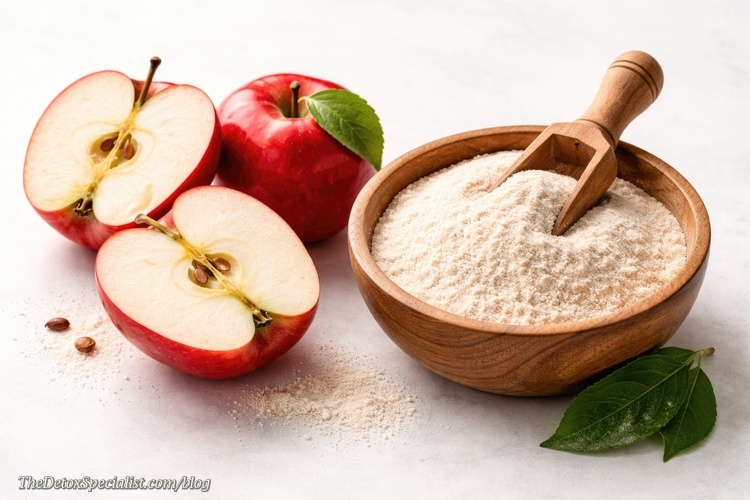
Apples are the most well-known pectin source, and for good reason — they contain particularly high concentrations, especially in and just under the skin. Citrus fruits are another standout, with the highest pectin content sitting in the white pith and peel rather than the juice. Berries including plums, gooseberries, and blackberries also rank among the highest-pectin fruits you can eat. The general rule is that slightly underripe fruit contains more pectin than fully ripe fruit, since the ripening process gradually breaks pectin down.
- Apples — especially with skin on; one of the richest whole-food pectin sources available (see recipe below)
- Citrus fruits — oranges, lemons, grapefruits; pectin is concentrated in the peel and pith
- Plums — high pectin content, particularly when slightly underripe
- Gooseberries and blackberries — among the highest-pectin berries by weight
- Quince — one of the highest naturally occurring pectin concentrations of any fruit
Vegetables, Legumes, and Nuts That Contain Pectin
Pectin is not exclusive to fruit. Carrots are one of the best vegetable sources and are easy to eat raw, roasted, or blended into soups. Peas and green beans contribute meaningful amounts, and legumes like lentils contain pectin alongside other prebiotic fibers that make them particularly powerful for microbiome diversity. Nuts, while lower in pectin than fruits and vegetables, still contribute to your overall intake when eaten regularly as part of a varied diet.
How to Add More Pectin to Your Daily Diet
The practical goal is not to overhaul your diet overnight but to consistently layer in more pectin-rich foods across your meals. Microba recommends aiming for 3 to 5 grams of prebiotic fiber daily as a starting threshold for gut health benefits, and gradually increasing from there while drinking adequate water to support the gel-forming process in your intestines.
Start with breakfast. Adding sliced apple or berries to oats gives you a double prebiotic hit — pectin from the fruit and beta-glucan from the oats. A glass of fresh-squeezed orange juice with pulp, or simply eating the whole orange, contributes pectin that juice alone strips away.
If you are constipated then the recipe below for stewed cooking apples can be really helpful and a tasty way to add pectin to uyour diet. These are not dramatic changes, but they compound meaningfully over weeks and months.
At lunch and dinner, raw or lightly cooked carrots are one of the simplest upgrades you can make. Cooking vegetables does reduce some pectin content, but it remains substantial enough to make cooked carrots, peas, and legumes genuinely valuable. A side of lentils a few times per week can do as much for your microbiome as any probiotic supplement on the market.
Stewed Cooking Apples with Raisins and Cinnamon Recipe for Sluggish Bowels
A simple high-fiber recipe that naturally provides pectin from the apple skins, along with soluble fiber from raisins to help support regular bowel movements.
Ingredients
- 4 large unpeeled organic Bramley or other cooking apples
- 2 tablespoons organic raisins
- 1 teaspoon ground cinnamon
- 150–200 ml filtered water
- Optional: 1 teaspoon organic lemon juice
- Optional: small drizzle of raw honey after cooking
Method
- Wash the apples well and remove the cores, but leave the skins on since much of the pectin is found in and just beneath the peel.
- Chop the apples into small chunks.
- Add the apples, raisins, cinnamon, and water to a saucepan.
- Bring gently to a simmer, then cover and cook gently for 15–20 minutes until soft. Stir occasionally.
- Lightly mash with a fork if desired, leaving some texture.
- Add a little lemon juice or honey if you want extra flavor.
Why It May Help Constipation
- Bramley apples are naturally rich in pectin, a soluble fiber that helps soften stool and support beneficial gut bacteria.
- Apple skins add insoluble fiber, which can help bowel motility.
- Raisins contain fiber and natural sorbitol, which may gently encourage bowel movements.
- Cinnamon can support digestion and adds sweetness without much sugar.
Serve 2 tablespoons warm on its own, with plain yogurt, or over porridge for a gut-friendly breakfast or dessert.
Pectin Compared to Other Prebiotic Fibers
Each prebiotic fiber has a distinct fermentation profile, feeds a slightly different community of gut bacteria, and produces SCFAs in different ratios. This is precisely why dietary diversity matters so much for gut health. Relying on a single prebiotic source — even one as effective as pectin — will always be less powerful than eating a wide variety of prebiotic-rich foods that collectively nourish a broader, more resilient microbial community.
That said, understanding how pectin compares to specific fibers helps you make smarter choices about what to prioritize based on your individual gut health goals.
Pectin vs. Resistant Starch
Resistant starch, found in cooked and cooled potatoes, green bananas, and legumes, is one of the most potent butyrate producers among all prebiotic fibers. In that specific regard, it edges out pectin. However, pectin’s gel-forming ability gives it a distinct advantage for gut barrier protection and bowel regularity that resistant starch does not replicate as effectively. They are complementary rather than competitive — eating both regularly gives you a broader range of benefits than either fiber alone.
Resistant starch is also more rapidly fermented than pectin, which means it delivers a faster burst of SCFA production but with a shorter duration. Pectin’s slower fermentation rate produces a more sustained SCFA release further along the colon, reaching sections of the gut that rapidly-fermented fibers sometimes do not adequately feed.
Pectin vs. Arabinoxylan
Arabinoxylan is a prebiotic fiber concentrated in wheat bran and whole grain cereals. It is one of the most researched fibers for its ability to increase microbial diversity across a broad range of bacterial species simultaneously. Where pectin tends to selectively feed specific strains like Bifidobacterium and Akkermansia, arabinoxylan casts a wider net, stimulating a more diverse cross-section of the microbiome in a single fermentation cycle.
That selectivity is not a weakness of pectin — it is a feature. Targeted feeding of keystone bacterial species like Akkermansia muciniphila can have an outsized positive impact on gut barrier function that broad-spectrum fermentation does not always replicate with the same intensity. The two fibers serve different but complementary roles in a well-rounded gut health diet.
If your diet already includes whole grain bread, wheat bran cereals, or oat-based foods, you are likely getting some arabinoxylan. Adding apple slices, carrots, and citrus to that foundation means you are now feeding your microbiome from two distinct angles — a significantly more effective strategy than optimizing for just one fiber type.
Why Eating a Variety of Prebiotic Fibers Is the Smartest Approach
- Different fibers feed different bacterial species — no single fiber can nourish your entire microbiome on its own
- Fermentation rates vary — a mix of fast and slow-fermenting fibers ensures SCFA production is sustained throughout the colon, not just in one section
- Dietary diversity directly correlates with microbiome diversity — a more diverse microbiome is consistently associated with better overall health outcomes
- Different fibers produce different SCFA ratios — combining pectin, resistant starch, beta-glucan, and arabinoxylan gives your gut a more complete metabolic toolkit
- Gradual introduction of multiple fiber types reduces the digestive discomfort that can come from suddenly increasing any single fiber dramatically
Your microbiome is not a single organism — it is an ecosystem made up of hundreds of bacterial species that each have different nutritional preferences. Feeding it with only one type of prebiotic fiber is like planting a garden with only one species. It might grow, but it will never be as resilient, productive, or balanced as a garden with genuine diversity.
The most practical way to apply this is through what nutritionists sometimes call eating the rainbow — not just in terms of color, but in terms of fiber variety. Apples and oats at breakfast, lentils at lunch, carrots and whole grain bread at dinner gives you pectin, beta-glucan, resistant starch, and arabinoxylan across a single day without any special effort or supplementation.
It is also worth noting that the 3 to 5 grams of prebiotic fiber referenced as a starting point is a combined target across all fiber types, not a per-fiber goal. So building a varied diet that hits that threshold from multiple sources is always going to outperform hitting it from a single source.
Once you establish that foundation, increasing toward higher daily prebiotic fiber intake becomes easier because your gut bacteria have already adapted to processing a variety of substrates. The key is consistency over time, not perfection on any single day.
A Gut Rich in Good Bacteria Starts With What You Eat Every Day
The research is clear and the mechanism is well understood: your gut bacteria thrive or struggle based almost entirely on what you feed them consistently over time. Prebiotic fibers like pectin are not supplements or interventions — they are the baseline nutritional requirement that your microbiome has always needed and that the modern processed-food diet has systematically removed. Getting them back into your diet through whole foods is not a trend. It is a return to how human guts were designed to be fed.
Probiotics have their place, but Microba and other gut health researchers are consistent on one point: probiotic supplements are unregulated, vulnerable to degradation through improper storage, and largely ineffective without adequate prebiotic fiber to sustain the bacteria they introduce. Food first is not just a preference — it is the more reliable and evidence-supported strategy for long-term gut health.
Daily Habit Prebiotic Fiber Delivered Additional Benefit Apple with skin as a snack Pectin Supports bowel regularity and gut barrier function Overnight oats with berries Beta-glucan + Pectin Cholesterol support and microbiome diversity Lentil soup at lunch Resistant starch + Pectin Strong butyrate production, sustained SCFA release Raw carrots as a side Pectin Protects gut lining, feeds Akkermansia Whole grain bread with dinner Arabinoxylan Broad-spectrum microbial diversity support
You do not need a complex protocol or a stack of supplements to build a healthier gut microbiome. The table above represents a completely achievable, ordinary day of eating that delivers prebiotic fiber variety across every meal. Start there, stay consistent, and your gut bacteria will do the rest.
Related reading: Microbiome Diet Your Pathway to Better Health
Frequently Asked Questions
Here are answers to the most common questions about pectin and its role in prebiotic gut health, covering everything from food sources to safety considerations.
Is Pectin the Same as the Pectin Used to Make Jam?
Yes and no. The pectin used in jam-making is the same compound — a plant-based polysaccharide extracted primarily from apple pomace or citrus peel. The key difference is concentration and context. Commercial pectin sold for jam-making is a highly concentrated extract designed to trigger rapid gelling at high temperatures with added sugar.
The pectin you consume through whole fruits and vegetables is present in its natural structural form within the plant’s cell walls. It behaves more gently in your digestive system, forming the slow, sustained gel that prebiotically feeds your gut bacteria rather than setting instantly like it does in a jam pot. Eating an apple is nutritionally very different from consuming a spoonful of commercial pectin powder, even though the underlying molecule is chemically related.
How Much Pectin Do You Need Per Day for Gut Health Benefits?
A total prebiotic fiber intake of 3 to 5 grams per day is the threshold cited as a starting point for measurable gut health benefits. Pectin does not need to account for all of that on its own — it works best as part of a combined intake across multiple prebiotic fiber types. Eating one medium apple with skin, a serving of cooked carrots, and a handful of berries in a day will comfortably put you in a meaningful range for pectin specifically, while a varied diet of whole plant foods covers the broader prebiotic spectrum.
Can You Take Pectin as a Supplement Instead of Eating It in Food?
Pectin supplements exist and are generally considered safe, but whole food sources are consistently the preferred option among gut health researchers. Supplements deliver isolated pectin without the accompanying vitamins, minerals, antioxidants, and diverse fiber types that whole fruits and vegetables provide simultaneously. Probiotic and prebiotic supplements are also unregulated, meaning concentration, purity, and efficacy can vary significantly between products. If a specific therapeutic use is being considered — such as managing cholesterol or acute bowel irregularity — a supplement may be discussed with a healthcare provider, but for general gut microbiome support, food is the more complete and reliable delivery mechanism.
How Long Does It Take for Pectin to Improve Gut Microbiome Health?
Gut microbiome composition can begin shifting within days of meaningful dietary change, but noticeable and sustained improvements in gut health markers typically develop over several weeks of consistent prebiotic fiber intake. Some people report changes in bowel regularity within the first week of adding more pectin-rich foods, while broader microbiome diversity improvements are generally more evident over a four to eight week period of consistent dietary change.
The critical factor is consistency rather than quantity on any single day. Your gut bacteria adapt incrementally to new food substrates, and a gradual, sustained increase in pectin-rich whole foods will always produce more durable microbiome changes than a short-term dietary spike followed by a return to low-fiber eating.
Is Pectin Safe for Everyone Including Children and People With IBS?
For the vast majority of people, pectin from whole food sources is completely safe and well-tolerated across all ages. Because it ferments more slowly and gently than some other prebiotic fibers like inulin, it tends to produce less gas and bloating, making it one of the more comfortable prebiotic options for people with sensitive digestive systems.
For people with Irritable Bowel Syndrome (IBS), the picture is more nuanced. Some IBS subtypes respond well to soluble fiber like pectin, particularly those involving constipation-predominant symptoms. However, individuals following a low-FODMAP diet as part of IBS management should be aware that some high-pectin fruits — particularly apples and certain stone fruits — are also high in FODMAPs, which can trigger IBS symptoms in sensitive individuals. In those cases, lower-FODMAP pectin sources like carrots and strawberries are worth prioritizing.
Children can safely consume pectin through normal whole food intake without any special considerations. As with any significant dietary change, anyone managing a diagnosed digestive condition should consult with a qualified healthcare provider before dramatically increasing prebiotic fiber intake, simply to ensure the approach aligns with their individual management plan.
For personalized gut microbiome testing and evidence-based dietary guidance, Microba offers practitioner-grade resources designed to help you understand exactly what your gut needs to thrive.